Help - I’m procrastinating!
Executive Function Strategies to Get Started and Get Things Done
Why is it so hard to finish a project or task on time? In my one-on-one coaching work, I often ask clients to name it — what’s really getting in the way?
Here are some of the most common responses I hear:
I don’t know what to do.
I don’t know how to start.
I’m dreading the start.
I don’t know how long it will take.
I’m afraid it’ll take forever to finish.
I’m afraid I won’t do a good job.
I haven’t planned enough time.
I have too much time before the deadline.
Other commitments get in the way.
Distractions make it even harder.
I just don’t want to do it.
I think I perform better under pressure.
Sound familiar?
The Procrastination Loop
So what happens? We procrastinate.
“I’ll do it later,” we tell ourselves.
And sometimes, we do.
But other times, it feels almost impossible to get started—especially for people with Executive Function challenges or ADHD, whose brains often struggle with task initiation.
Illustrator Dani Donovan captures this perfectly in her webcomics. One of my favorites shows the never-ending cycle between:
“Stressed about not getting anything done”
and
“Too stressed to start on anything.”
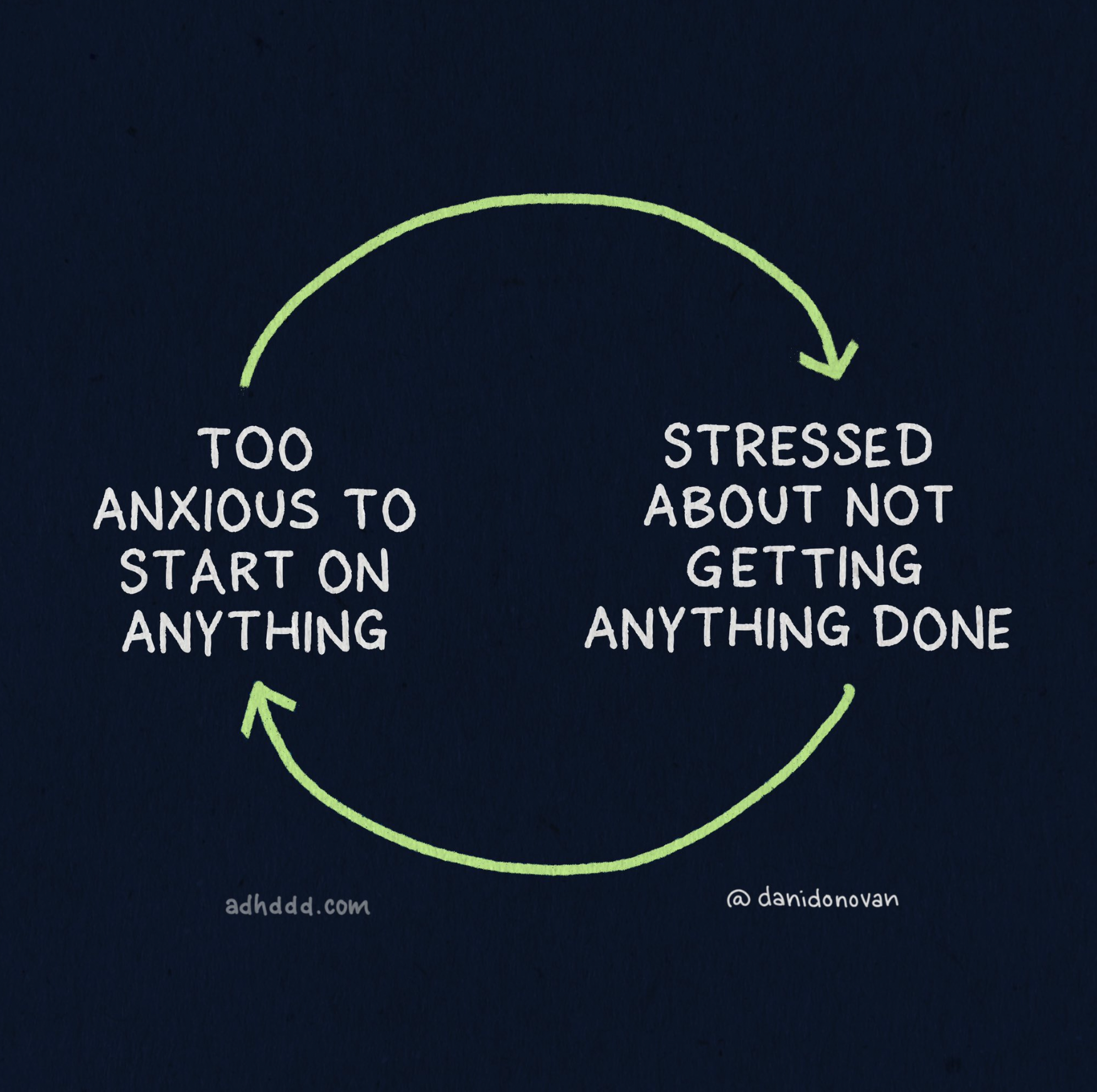
Around and around it goes.
If that loop sounds familiar, you’re not alone.
Break the Cycle with “Chunking”
When a task feels monumental (or simply undesirable), one of the best strategies is something we call “chunking” in the Executive Function world.
Chunking means breaking a big task into smaller, doable steps — small enough that your brain says, “Okay, I can handle that.”
If getting started feels impossible, your first step is probably still too big.
Shrink it again. Any progress is progress.
Chunking by Task
Break the project itself into micro-steps:
“For now, I’m just going to take out the project description and gather my materials.”
“I’ll finish this one email before taking a break.”
Chunking by Time
Give yourself a short, defined work session:
“For the next 10 minutes, I’ll work on this math assignment.”
“I’ll clean the kitchen for 5 minutes.”
Then set a timer and stop when it beeps.
That’s it! Don’t commit to more than that at first.
Sometimes, once you’ve started, momentum builds naturally. If that happens, great — set another small goal and another timer.
Writing down each mini-goal can make this strategy even more effective.
When Chunking Isn’t Enough: The Three W’s
If chunking still doesn’t get you unstuck, Dr. Sasha Hamdani, board-certified psychiatrist and author of Self-Care for People with ADHD, recommends the three W’s.
Walk – Take a short walk. Even a trip to the mailbox or around the room can reset your brain.
Water – Drink a glass of water. Hydration supports focus and brain function.
Wait it out – Still not ready? Set a 7-minute timer and come back to it. Sometimes your brain just needs a reset.
These small shifts help calm stress, regulate energy, and prepare your brain to engage again.
Procrastination Isn’t Laziness
People who procrastinate are often labeled as lazy — but that’s rarely true.
Brains are complicated. Procrastination is often a brain-based challenge, not a character flaw.
By using tools like chunking, timers, and the Three W’s, you can trick your brain into taking that crucial first step — and keep the cycle moving forward.
And always remember:
We must be gentle with ourselves.
Change doesn’t happen overnight.
Little by little, progress happens.
Sign up here to receive Carrie’s new Sunday email series, The Sunday Brain Boost. Simple strategies to help students thrive, one Sunday at a time.
Carrie Bonnett is a veteran teacher and Executive Function coach based in Bend, OR. Carrie works with students and families (and adults, too). Her coaching empowers students to thrive in life and in school, helps parents and teachers to better support their children, and guides adult to get on top of all that life requires. In addition to coaching, she is also an adjunct instructor for early-career teachers at University of Portland in Oregon.For more information, visit www.carriebonnett.com