Planning With Time in Mind: A Smarter Way to Use a To-Do List
Most to-do lists are good at one thing: telling us what needs to get done.
What they don’t tell us? How long those things will take.
That missing piece makes planning harder than it needs to be—especially for kids (and adults) who struggle with time awareness. When everything looks the same on a list, it’s easy to assume it will all fit… until it doesn’t.
That’s why I often teach a simple strategy called time circles.
The Problem With Traditional To-Do Lists
When a list is just words, every task feels equal.
“Math homework” and “email teacher” sit side by side, even though one might take 45 minutes and the other takes two.
This makes it harder to:
Plan a realistic afternoon or evening
Choose what fits into a short window of time
Avoid the classic “I’ll just squeeze this in” trap
For students who already struggle with time, this often leads to frustration, avoidance, or giving up altogether.
The Time Circles Strategy
That’s why I teach my clients to use time circles.
Next to each task on the list, draw a small circle. Then fill it in based on how long you expect the task to take.
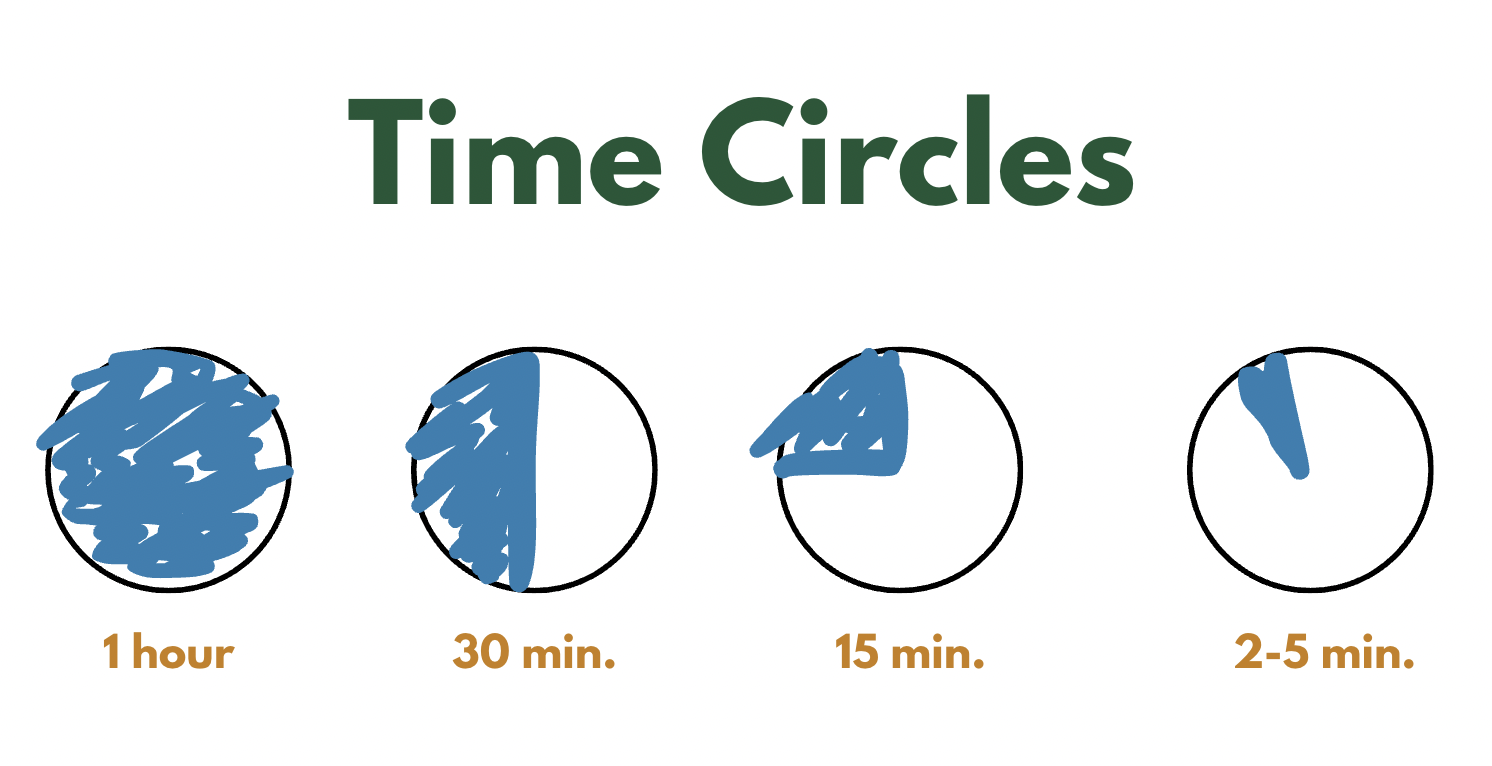
Now your list holds much more useful information. At a glance, you can see which tasks fit into a short window of time—and which ones need a bigger chunk of focus.
I just used this strategy with a client I met with this week. It’s the end of the semester, and he has seven or eight missing assignments that have to be finished. On paper, the list felt overwhelming—everything looked urgent and heavy.
Once we added time circles next to each assignment, things shifted. Some tasks were full circles, but others were much smaller than he expected. Suddenly, he could see what could realistically fit into one afternoon, what needed to be spread across a few days, and where short tasks could be tucked in between bigger ones.
Time circles help students (and adults!) be more realistic about what can actually fit into an afternoon or evening. They also reduce that “I’ll just squeeze this in” thinking that often leads to frustration. When time is visible, planning becomes clearer—and starting feels more doable.
Grab a pen and give it a try. Your to-do list just got smarter.
Why This Works
Time circles make time visible.
Instead of relying on vague estimates in your head, you’re externalizing time onto the page. This supports executive function skills like planning, prioritizing, and self-monitoring—without adding complexity.
Students often become more realistic once they see their list laid out this way. It’s no longer about motivation or effort; it’s about math. You can’t fit three full circles into a 45-minute afternoon, no matter how hard you try.
And that clarity reduces friction.
How to Try It
You don’t need a special planner or app. Grab a pen, look at today’s list, and add circles.
You can adjust as you go—part of the learning is noticing when something took longer or shorter than expected. That awareness is the skill.
Your to-do list just got smarter.
And remember: little by little, change happens.
Sign up here to receive Carrie’s Sunday email series, The Sunday Brain Boost. Simple strategies to help students thrive, one Sunday at a time.
Carrie Bonnett is a veteran teacher and Executive Function coach based in Bend, OR. Carrie works with students and families (and adults, too). Her coaching empowers students to thrive in life and in school, helps parents and teachers to better support their children, and guides adult to get on top of all that life requires. In addition to coaching, she is also an adjunct instructor for early-career teachers at University of Portland in Oregon. For more information, visit www.carriebonnett.com