Executive Function Strategies: Shopping Around to Find What Works for Your Child
Have you ever felt like you’ve tried every Executive Function strategy…and nothing works?
If so, you’re not alone. I hear this from parents and teachers all the time.
And honestly? It makes sense. When a student is struggling, the natural response is to try different strategies to see what helps. That’s actually a good thing.
But without understanding why a strategy works—or what skill it’s supporting—it can start to feel like you’re just guessing and hoping something sticks.
But here’s the shift I want you to consider:
It’s not about finding the one perfect strategy. It’s about finding the right strategy for this unique brain.
And that takes a little bit of what I call “strategy shopping.”
What is Strategy Shopping?
Strategy shopping is exactly what it sounds like.
Instead of expecting one tool or technique to solve everything, we try different strategies, notice what works, and adjust along the way. Because here’s the truth: No single strategy works for every student—or even for the same student all the time.
There’s no one perfect tool.
I don’t hand a student a planner and say, “This is the one.”
What works beautifully for one student might not work at all for another. That’s why a little strategy shopping is so important.
Brains are variable. Needs change. Context matters.
So we should “shop around.”
A Simple Way to Think About Strategy Shopping
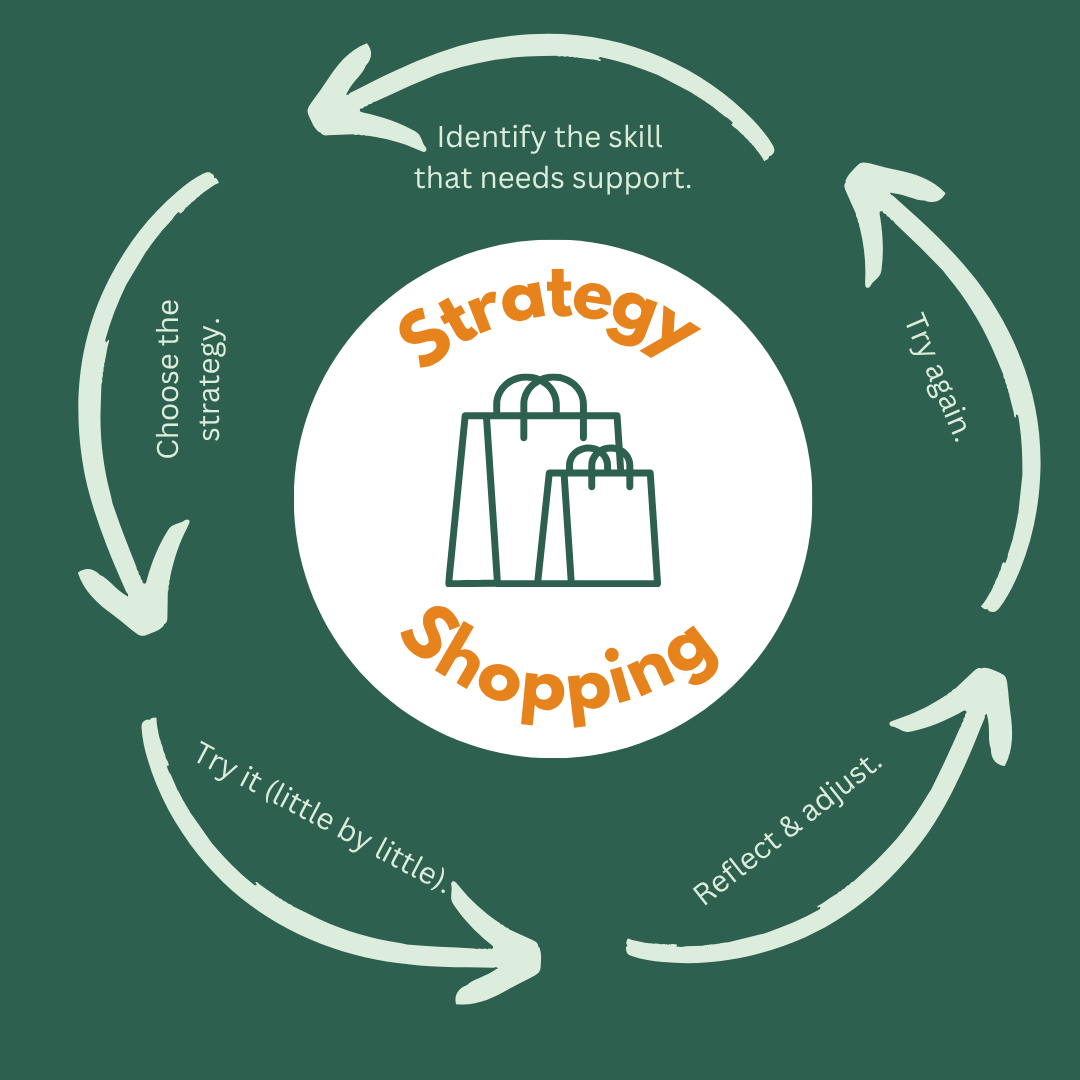
Strategy shopping doesn’t have to feel overwhelming. You can think of it as a simple 4-step cycle:
Identify the skill → Choose a strategy → Try it → Reflect and adjust → Repeat
Here’s what that looks like in practice:
1. Identify the skill
What’s actually hard right now? Getting started? Staying organized? Managing time?
2. Choose a strategy
Pick one strategy that supports that skill.
3. Try it (little by little)
Keep it simple, visible, and realistic.
4. Reflect and adjust
Did it help? Do you tweak it—or try something new?
Then repeat the cycle.
Why Strategies “Don’t Work”
You may hear about a strategy and think, “We’ve already tried that.” In fact, kids often say this to me. They say things like, “Planners don’t work for me” or “I don’t like writing things down.”
Totally fair.
But I want to gently challenge that thought.
Because often, it’s not that the strategy didn’t work—it’s that something underneath it wasn’t in place yet. What if you tried it again—with a different understanding of the brain?
For example:
Is the student regulated and feeling supported?
(Connection with your child is the most important thing.)Do we understand the skill that’s actually struggling?
(Is this about task initiation, working memory, planning or something else?)Are we using brain language - i.e. “Your brain is struggling with focus.”)?
(Or are we still framing the challenge as a motivation or effort issue?)Is there enough structure, routine, and consistency in place?
(Brains love structure, even though some humans don’t.)Was the strategy visible and accessible?
(Out of sight is truly out of mind for many brains.)Did we give it enough time?
(Progress is measured in baby steps.)
These things matter. Without them, even the best strategies can fall flat.
When you layer in emotional regulation, structure, realistic expectations and a “little by little” mindset,
the same strategy can land differently.
A Few Reminders Before You Start
As you do some strategy shopping, keep these in mind:
Little by little matters.
Change doesn’t happen overnight.
Something is always better than nothing.
Even small steps count.
Be gentle—with your student and yourself.
This is a learning process for both of you.
Time to “Shop Around”
My role as a coach is to introduce lots of strategies and tools to my clients.
Some will work. Some won’t. Some will work for a while and then stop working.
That’s not failure—that’s part of the process.
Because when you find the right strategy for the right moment?
That’s when things start to click.
Sign up here to receive Carrie’s Sunday email series, The Sunday Brain Boost. Simple strategies to help students thrive, one Sunday at a time.
Carrie Bonnett is a veteran teacher and Executive Function coach based in Bend, OR. Carrie works with students and families (and adults, too). Her coaching empowers students to thrive in life and in school, helps parents and teachers to better support their children, and guides adult to get on top of all that life requires. In addition to coaching, she is also an adjunct instructor for early-career teachers at University of Portland in Oregon.For more information, visit www.carriebonnett.com