Big assignments and projects can feel overwhelming.
A research paper, a project, a presentation, studying for finals—these tasks often feel so big that students don’t know where to begin. When that happens, the brain tends to do one of two things: procrastinate or panic.
There’s a better way.
One of the most helpful strategies I teach my clients is planning backward. When combined with sticky notes and time circles, it becomes a powerful tool for turning a big assignment into a clear, manageable plan.
Step One: Start With the Due Date
Planning backward begins at the end.
Write “Turn it in” on a small sticky note and place it on your desk WAY to the right.
Then ask a simple question:
What step needs to happen right before this one?
Maybe the final step is submitting the assignment, printing it, or uploading it online.
Write that step down on a sticky note and place it next to the first one.
Step Two: Break the Assignment Into Small Steps
Next, work backward by identifying the small steps - one by one - that must happen right before that. Repeat this until you arrive at the “beginning” - processing the assignment’s instructions.
For example, a research paper might look something like this:
Submit the paper
Final edit and proofreading
Create the Works Cited page
Write the conclusion
Write the body paragraphs
Organize notes and outline
Gather research sources
Choose a topic
Each step gets its own sticky note.
This is important. When every step lives on a separate note, it becomes easier to move them around, rearrange them, and visualize the process.
Sometimes, you might want to separate the writing into multiple sticky notes. That way, you don’t feel like you need to do all the writing in one sitting.
Suddenly, the assignment doesn’t feel like one giant task. It’s a series of smaller steps.
Step Three: Estimate Time Using Time Circles
Now it’s time to add one more helpful layer: time awareness.
Most to-do lists tell us what needs to be done—but not how long each step will take. That missing piece makes planning much harder.
Next to each sticky note, draw a time circle to estimate how long that step might take:
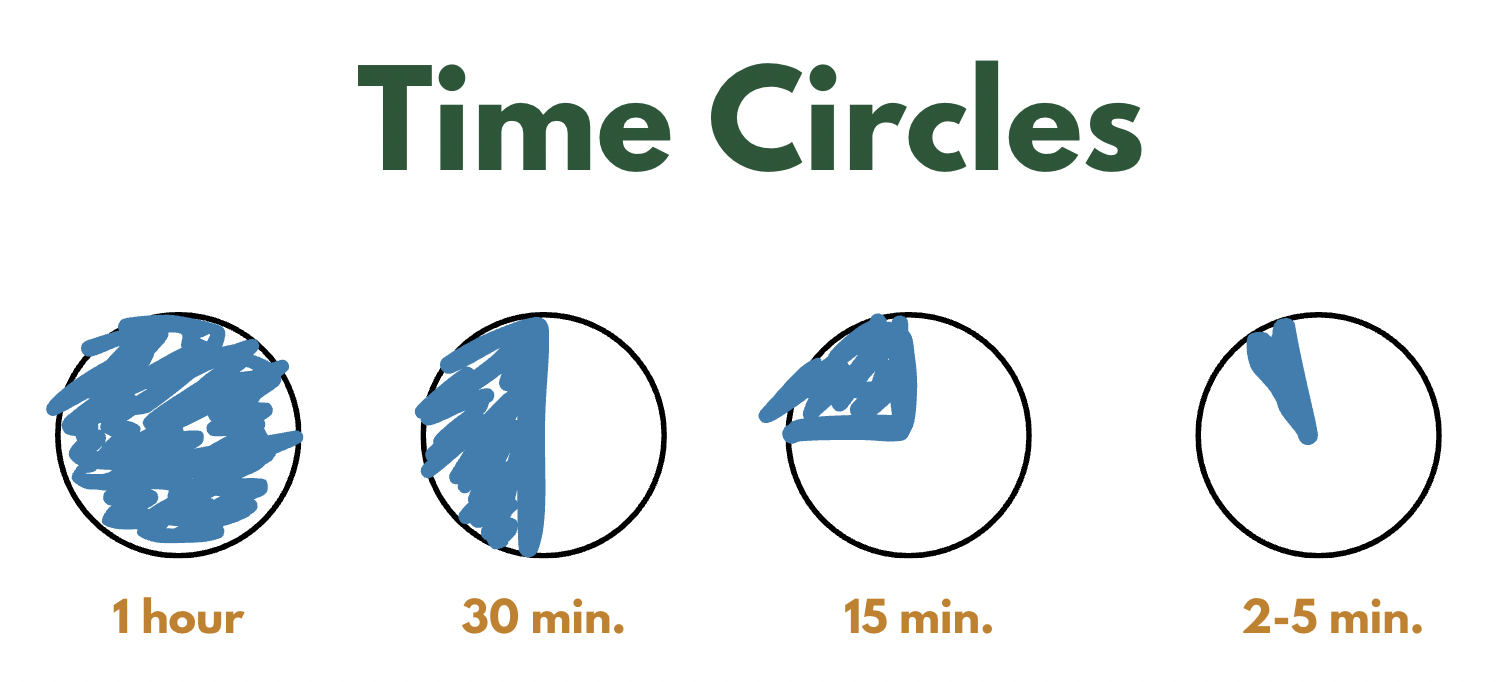
Once the time circles are added, the plan becomes much clearer. Students can see which steps are quick wins and which ones require a longer block of focus.
Step Four: Place the Steps on the Calendar
Now take those sticky notes and begin placing them on the days leading up to the due date. I actually like to start at the deadline, placing “Turn it in” on the day it’s due and working backwards.
Because each step already has a time estimate, it’s easier to see what can realistically fit into an afternoon or evening.
Instead of trying to do everything the night before, the work is spread out over several days.
This is where the magic happens.
Why This Strategy Works
Planning backward helps students see the full path from beginning to end.
Sticky notes make the process visual and flexible.
Time circles add realistic time awareness.
Together, these tools transform a big assignment from something vague and intimidating into something concrete and manageable.
Start Small
The next time a big assignment is given, try this approach:
Break it into steps.
Write each step on a sticky note.
Add time circles.
Then place the steps on the calendar.
It might take a few extra minutes at the beginning—but it can save hours of stress later.
Sign up here to receive Carrie’s Sunday email series, The Sunday Brain Boost. Simple strategies to help students thrive, one Sunday at a time.
Carrie Bonnett is a veteran teacher and Executive Function coach based in Bend, OR. Carrie works with students and families (and adults, too). Her coaching empowers students to thrive in life and in school, helps parents and teachers to better support their children, and guides adult to get on top of all that life requires. In addition to coaching, she is also an adjunct instructor for early-career teachers at University of Portland in Oregon.For more information, visit www.carriebonnett.com